
Table of Contents
- Perplexity vs. ChatGPT: The 60-Second Answer
- Feature-by-Feature Breakdown: A Head-to-Head Comparison
- The Final Verdict: Who Should Use Which Tool?
In the rapidly evolving world of artificial intelligence, two names frequently come up: Perplexity and ChatGPT. Both are incredibly powerful tools, but they are built for fundamentally different purposes. Choosing the right one can dramatically boost your productivity, while using the wrong one can lead to frustration. This guide will break down the key differences, strengths, and ideal use cases to help you choose the perfect AI tool for your research, writing, and productivity needs.
Perplexity vs. ChatGPT: The 60-Second Answer
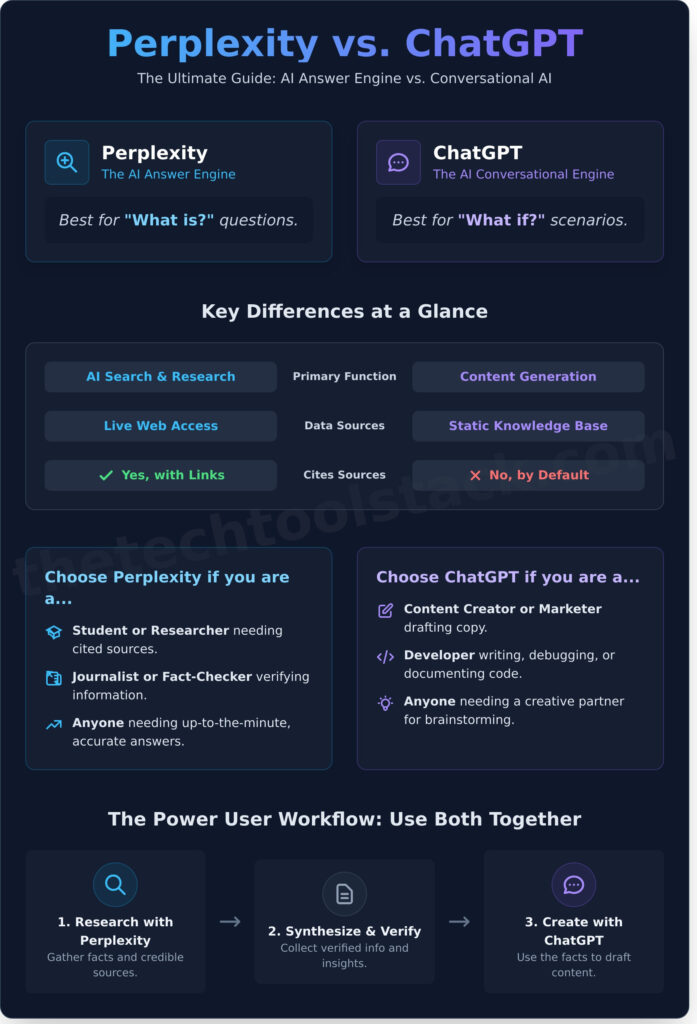
If you only have a minute, here’s the essential takeaway. The choice between these two tools comes down to one simple question: Are you looking for answers or are you looking to create something new?
Perplexity is an AI Answer Engine: Think of it as a supercharged search engine. Its primary job is to scan the web in real-time to find and synthesize accurate, up-to-date information, complete with citations. It’s best for research and finding verifiable facts.
ChatGPT is an AI Conversational Engine: This is your creative partner and general-purpose assistant. Its strength lies in generating text, brainstorming ideas, summarizing content you provide, writing code, and engaging in complex conversations.
A simple way to remember it is to use Perplexity for “What is?” questions and ChatGPT for “What if?” scenarios.
Key Differences at a Glance
| Feature | Perplexity | ChatGPT |
|---|---|---|
| Primary Function | AI-powered search and research | Conversational AI and content generation |
| Data Sources | Live, real-time web access | Static knowledge base (with limited live browsing for Plus users) |
| Citing Sources | Yes, provides direct links to sources | No, does not cite sources by default |
| Core Strength | Accuracy, verification, and up-to-date information | Creativity, text generation, and task execution |
Feature-by-Feature Breakdown: A Head-to-Head Comparison
Let’s dive deeper into the features that matter most to users. Understanding how each tool performs in critical areas like accuracy and usability will help clarify which one fits your workflow.
Accuracy & Data Sources: The Biggest Divide
The most significant difference between Perplexity and ChatGPT lies in how they access information. Perplexity’s greatest strength is its real-time web access. When you ask a question, it actively scours the internet for the most current information, which is crucial for topics that change quickly. Critically, Perplexity provides citations for its answers, showing you exactly where it got the information. This allows you to verify facts and trust the output, making it an invaluable tool for research.
ChatGPT, on the other hand, primarily relies on its massive but static training data, which has a knowledge cutoff date. While its browsing capabilities for Plus users are improving, its core function isn’t to be a search engine. This lack of default source citation means you must independently fact-check any critical information it provides.
Core Use Cases: Research vs. Creation
Because of their different designs, each tool shines in different scenarios.
Perplexity is the clear winner for any task requiring factual accuracy and sourcing. It excels in academic research, market analysis, and quick fact-finding. A powerful, often overlooked feature is its ‘Focus’ mode, which allows you to narrow your search to specific sources like Academic papers, Wolfram|Alpha for computational data, YouTube for video content, or Reddit for public opinion.
ChatGPT is the champion of creation and execution. It’s the ideal assistant for writing first drafts of articles, brainstorming marketing slogans, generating social media posts, writing and debugging code, or acting as a creative partner. Its conversational nature allows you to refine ideas iteratively, making it a flexible tool for a wide range of creative and professional tasks.
Advanced Features & Pro Plans
Both services offer paid subscriptions that unlock more powerful features. When comparing Perplexity Pro vs. ChatGPT Plus, the better value depends entirely on your needs.
Perplexity Pro gives you a choice of advanced AI models (like GPT-4o and Claude 3), unlimited file uploads for analysis, and a higher number of “Copilot” queries (their guided AI search feature). This is best for researchers and professionals who need maximum power for data analysis and verification.
ChatGPT Plus gives you priority access to OpenAI’s latest models like GPT-4o, the ability to generate images with DALL-E 3, and advanced tools like data analysis with file uploads. This plan is ideal for creators, developers, and business users who need a versatile, all-in-one AI assistant.
The Final Verdict: Who Should Use Which Tool?
Now that we’ve covered the details, here are our clear recommendations based on your job role or task. This will help you make a final, confident decision.
Choose Perplexity if You Are a…
- Student, researcher, or academic who needs properly cited sources for papers and projects.
- Journalist or fact-checker who must verify information from multiple, reliable sources quickly.
- Anyone who needs accurate, up-to-the-minute answers on current events, market trends, or technical topics.
Choose ChatGPT if You Are a…
- Content creator, marketer, or copywriter who needs to draft articles, emails, and social media content efficiently.
- Developer who is writing, documenting, or debugging code.
- Anyone who needs a creative partner for brainstorming, summarizing long documents, or planning projects.
The Power User Workflow: Using Both Together
The smartest professionals don’t choose one over the other—they use them together. For maximum efficiency, try this simple workflow:
- Use Perplexity to conduct your initial research, gather key facts, and collect a list of credible, sourced information.
- Copy the verified information and insights you’ve gathered from Perplexity.
- Paste that context into ChatGPT and ask it to draft an article, create a presentation outline, or write an email based on the factual foundation you provided.
This method combines Perplexity’s accuracy with ChatGPT’s creative power, giving you the best of both worlds.

Michael Mucunguzi is the Lead Tech Reviewer at TheTechToolStack. With years of experience navigating the East African digital landscape, Michael specializes in helping Ugandan entrepreneurs and bloggers find reliable global tools that work seamlessly with local systems. Based in Kampala, he focuses on bridging the gap between international software and local accessibility.
Last modified: December 20, 2025