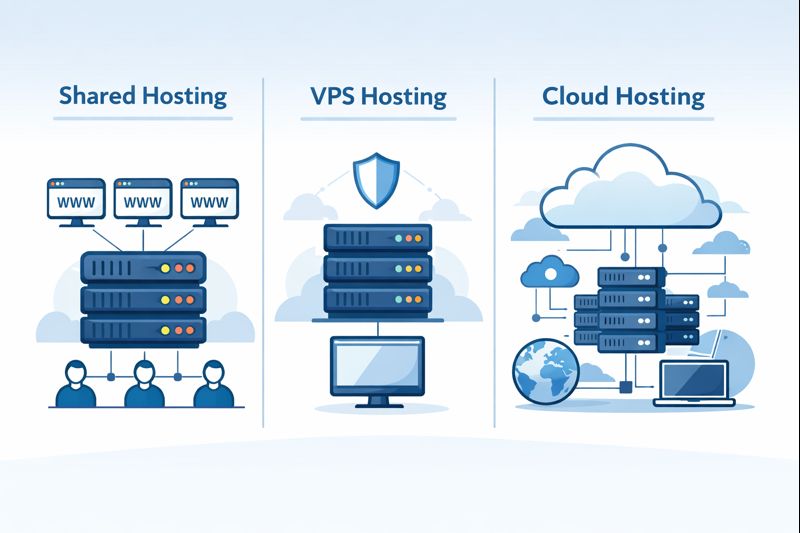
When building or managing a website, one of the most important technical decisions is choosing the right type of web hosting. For many website owners—especially beginners—the terms shared hosting, VPS hosting, and cloud hosting can be confusing or misunderstood. Each hosting type works differently and is designed to support websites at different stages of growth.
This article explains how shared, VPS, and cloud hosting function, highlights their key differences, and outlines common use cases. The goal is to help readers understand website hosting types clearly, without recommending any specific provider or service.
What Is Web Hosting?
Web hosting is a service that stores a website’s files—such as text, images, and databases—on servers that are connected to the internet. When someone visits a website, their browser communicates with the hosting server to retrieve and display those files.
The primary difference between hosting types lies in how server resources are allocated, how much control the website owner has, and how performance is managed as traffic changes.
Understanding these differences helps website owners choose hosting that aligns with their technical needs and growth expectations.
Shared Hosting: A Common Starting Point
How Shared Hosting Works
Shared hosting places multiple websites on a single physical server. All websites hosted on that server share the same pool of resources, including processing power, memory, storage, and network bandwidth.
A helpful analogy is an apartment building: each resident has a private living space, but utilities such as water and electricity are shared among all occupants.
Key Characteristics of Shared Hosting
- Multiple websites hosted on one server
- Shared access to server resources
- Minimal server management required
- Typically managed entirely by the hosting provider
Typical Use Cases
Shared hosting is commonly used for:
- Personal blogs
- Informational or portfolio websites
- Small organizations or NGOs
- Early-stage websites with low traffic
Limitations to Consider
Because resources are shared, performance can vary depending on the activity of other websites on the same server. If one site experiences a traffic spike or consumes excessive resources, others may be affected. Customization options are also limited, as users generally cannot modify server-level settings.
Shared hosting is often chosen for its simplicity rather than performance flexibility.
VPS Hosting: Greater Control and Predictability
How VPS Hosting Works
VPS (Virtual Private Server) hosting uses virtualization technology to divide a physical server into multiple independent virtual servers. Each VPS operates as if it were its own dedicated server, with a defined allocation of resources.
Using a housing analogy, VPS hosting is similar to a townhouse: individual units share the same property, but each has its own utilities and internal systems.
Key Characteristics of VPS Hosting
- Dedicated virtual resources
- Improved performance consistency
- Greater control over server configuration
- Isolation from other users on the same hardware
Typical Use Cases
VPS hosting is often used for:
- Growing blogs or content-heavy websites
- Business websites with moderate traffic
- Web applications requiring specific configurations
- Developers testing or deploying custom environments
Key Considerations
VPS hosting usually requires more technical knowledge than shared hosting, especially for unmanaged plans. Tasks such as server updates, security configurations, and performance optimization may fall on the website owner. While VPS hosting is more flexible, it also introduces additional responsibility.
Cloud Hosting: Flexible and Scalable Infrastructure
How Cloud Hosting Works
Cloud hosting distributes a website’s data across a network of interconnected servers rather than relying on a single physical machine. Resources can be allocated dynamically, allowing websites to scale up or down based on demand.
This model resembles an electricity grid: instead of drawing power from one generator, users draw from a network that adjusts supply as needed.
Key Characteristics of Cloud Hosting
- Resources distributed across multiple servers
- High scalability and redundancy
- Improved uptime through failover systems
- Usage-based resource allocation
Typical Use Cases
Cloud hosting is commonly used for:
- High-traffic or rapidly growing websites
- E-commerce platforms
- Media-rich or data-intensive applications
- Websites with unpredictable traffic patterns
Trade-offs
While cloud hosting offers flexibility, it can be more complex to understand, particularly for beginners. Pricing models are often usage-based, which may require closer monitoring to avoid unexpected costs. Management complexity can also vary depending on how the cloud environment is configured.
Performance, Scalability, and Control Compared
One of the main differences between shared, VPS, and cloud hosting is how they handle performance and growth.
| Feature | Shared Hosting | VPS Hosting | Cloud Hosting |
|---|---|---|---|
| Resource Allocation | Shared among users | Dedicated virtual resources | Distributed across servers |
| Performance Stability | Variable | Consistent | Highly adaptable |
| Technical Control | Very limited | Moderate to high | High |
| Scalability | Low | Moderate | High |
| Infrastructure Redundancy | Minimal | Limited | Strong |
This comparison highlights that no single hosting type is universally better; suitability depends on website needs and management capacity.
Common Mistakes When Choosing Web Hosting
When selecting a hosting type, website owners sometimes make avoidable mistakes, including:
- Choosing advanced hosting before it is necessary
- Underestimating or overestimating future growth
- Ignoring technical skill requirements
- Focusing on features instead of actual use cases
- Assuming higher cost automatically means better performance
Taking time to understand hosting fundamentals can help prevent unnecessary complexity.
How Hosting Needs Change Over Time
Many websites evolve through different hosting stages. A project may begin on shared hosting, move to VPS hosting as traffic grows, and later adopt cloud hosting for scalability or redundancy. This progression is not mandatory, but it reflects how hosting requirements often change as websites mature.
Evaluating hosting needs periodically allows site owners to align infrastructure with current goals rather than anticipated ones.
Final Thoughts
Shared hosting, VPS hosting, and cloud hosting each serve distinct purposes within the broader website hosting landscape. Understanding how these hosting types differ in structure, performance, and control allows website owners to make informed decisions based on their current needs and technical comfort level.
For many new websites, stability, simplicity, and room to grow are often important considerations, especially when advanced features may not yet be necessary. A clear understanding of hosting fundamentals provides a strong foundation for long-term website success.

Michael Mucunguzi is the Lead Tech Reviewer at TheTechToolStack. With years of experience navigating the East African digital landscape, Michael specializes in helping Ugandan entrepreneurs and bloggers find reliable global tools that work seamlessly with local systems. Based in Kampala, he focuses on bridging the gap between international software and local accessibility.
Cloud Hosting Shared Hosting VPS Hosting Web Hosting Web Hosting Types
Last modified: December 21, 2025