
Disclosure: We are a professional review site. When you buy through links on our site, we may earn an affiliate commission at no extra cost to you. This is how we keep TheTechToolStack running.
Table of Contents
- How to Choose the Right AI Learning Resource for You
Discover the top-rated courses, tutorials, and communities to go from AI beginner to expert, with options for every budget and learning style.
The world of Artificial Intelligence is expanding at an incredible pace, and the number of learning resources has exploded along with it. If you’re feeling overwhelmed by endless lists of courses, outdated tutorials, and conflicting advice, you’re not alone. The key to success isn’t finding more resources—it’s finding the right ones.
This guide cuts through the noise. We’ve curated the best, most relevant learning resources for mastering AI in 2026, whether you’re a complete beginner or a professional looking to upskill. This is your roadmap to building practical AI skills, with clear guidance on choosing a path that fits your goals, budget, and learning style.
How to Choose the Right AI Learning Resource for You
Before you dive into a course, a moment of planning can save you hundreds of hours. The best resource is one that aligns perfectly with your personal and professional objectives.
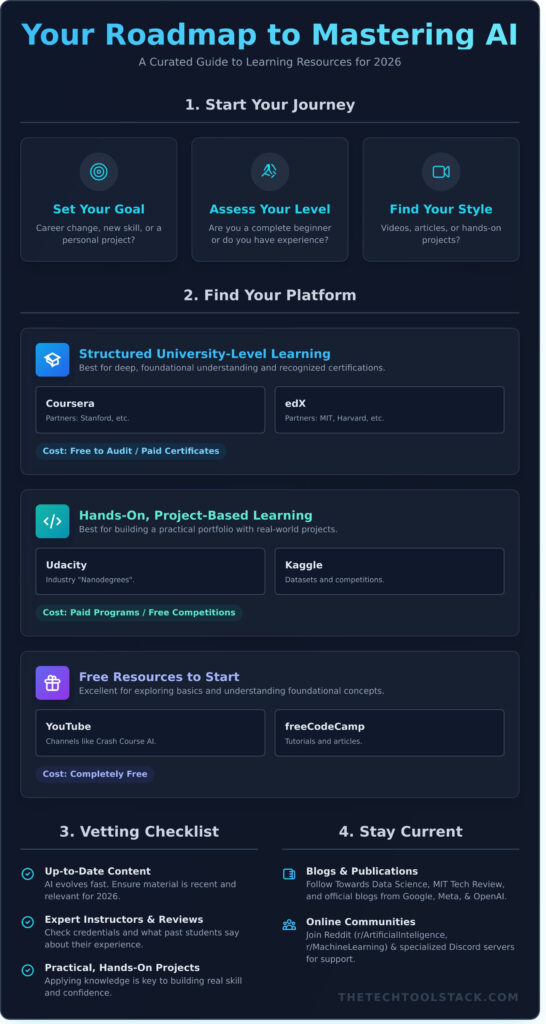
- Start with a clear goal. Why do you want to learn AI? Are you aiming for a career change into machine learning engineering, looking to apply AI to your current job, or simply building a personal project? Your goal dictates your path. A future data scientist needs a different curriculum than a marketer who wants to use AI for content creation.
- Assess your current knowledge. Be honest about your starting point. Do you have a background in programming (like Python) and statistics? Or are you starting from scratch? Many platforms cater to absolute beginners, while others assume a foundational level of technical skill.
- Consider your learning style. Do you learn best by watching video lectures, reading in-depth articles, or getting your hands dirty with code? Some platforms are academic and theoretical, while others are intensely project-based. Choose a format that keeps you engaged.
Free vs. Paid Resources: When Should You Invest?
One of the biggest questions for aspiring learners is whether to pay for a course. The answer depends on your goals and commitment level.
- Free resources are great for exploration. Platforms like YouTube and freeCodeCamp are perfect for testing the waters. You can learn foundational concepts, understand the terminology, and decide if AI is a field you’re passionate about without any financial risk.
- Paid courses offer structure, support, and certification. When you’re ready to commit, paid platforms like Coursera and Udacity provide a structured curriculum, expert support, and a certificate to add to your resume. This is ideal for career-focused learning where a credential can make a difference.
- A hybrid approach is often best. Start with free resources to build a foundation. Once you’ve identified a specific area you want to master (e.g., Natural Language Processing), invest in a high-quality paid course or specialization to deepen your expertise.
A Quick Checklist for Vetting Any AI Course
Not all courses are created equal. Before enrolling, run any potential resource through this simple three-point check:
- Recency: Is the course content recent? Check the publication or last update date. The AI field moves fast, and a course from three years ago may already be outdated.
- Credibility: Who is teaching the course? Look into the instructor’s credentials and, more importantly, read recent student reviews. What do learners who have completed the course say about it?
- Practicality: Does the curriculum include hands-on projects? True learning in AI happens when you apply concepts. A course that has you build a real project is far more valuable than one that is purely theoretical.
Top Learning Platforms & Courses for AI
We’ve analyzed and categorized the best platforms to help you find the perfect fit. This table gives a quick overview, with more detail on each platform below.
| Platform | Cost | Format | Best For… |
|---|---|---|---|
| Coursera & edX | Free to audit; Paid for certificates | University-style video lectures, quizzes, assignments | Building a strong theoretical foundation with academic rigor. |
| Udacity | Paid (premium) | Project-based “Nanodegrees” | Gaining job-ready skills and building a professional portfolio. |
| Kaggle | Free | Competitions, tutorials, datasets | Applying skills to real-world data and learning from the community. |
| freeCodeCamp & YouTube | Free | Video tutorials, articles, interactive coding | Starting from zero and learning core concepts without financial commitment. |
Best for Structured University-Level Learning: Coursera & edX
If you want a deep, academic understanding of AI and machine learning, look no further. Both Coursera and edX partner with world-class universities like Stanford, MIT, and Harvard to offer courses, specializations, and even full online degrees.
- What you’ll get: Access to high-quality lectures from top professors, structured assignments, and professional certificates that carry weight on a resume.
- Top courses: Andrew Ng’s “Machine Learning Specialization” on Coursera is widely considered the quintessential starting point for anyone serious about the field.
Best for Hands-On, Project-Based Learning: Udacity & Kaggle
If your goal is to build a portfolio and prove you can do the work, a project-based approach is essential.
- Udacity offers “Nanodegrees” that are co-created with industry leaders like Google and Amazon. The curriculum is focused entirely on completing real-world projects that you can showcase to potential employers.
- Kaggle is a must-use platform for any aspiring AI practitioner. It’s home to a massive collection of datasets, coding notebooks, and machine learning competitions. It’s the perfect environment to practice your skills, learn from others’ code, and see how you stack up against a global community.
Best Free Resources to Start Your Journey: YouTube & freeCodeCamp
You don’t need a big budget to get started. The quality of free educational content available today is staggering.
- freeCodeCamp offers a massive library of free, full-length courses on its YouTube channel and interactive lessons on its website. Their “Machine Learning with Python” course is a fantastic, comprehensive entry point.
- YouTube is home to countless brilliant educators. Channels like 3Blue1Brown offer incredible visual explanations of the math behind neural networks, while channels like StatQuest with Josh Starmer break down complex statistics in a simple, intuitive way.
Essential AI Blogs, Newsletters, and Communities
Learning AI doesn’t stop when you finish a course. The field evolves daily, and staying current is part of the job. These resources will help you keep your finger on the pulse.
Must-Read Blogs and Publications
- Towards Data Science: A Medium publication that features a huge range of articles from practitioners in the field, covering everything from tutorials to high-level concepts.
- MIT Technology Review: Provides expert analysis on the broader impact of AI on society and business, helping you understand the “why” behind the technology.
- Company AI Blogs: Follow the official AI blogs from Google, Meta, and OpenAI to get news and research breakthroughs straight from the source.
Newsletters That Bring AI News to Your Inbox
A curated newsletter is the most efficient way to keep up with the industry without getting overwhelmed. They deliver the most important developments directly to you.
Subscribe to our newsletter for the latest AI tool insights and expert-vetted guides.
Online Communities for Support and Networking
You’re not learning in a vacuum. Connecting with peers is invaluable for asking questions, getting feedback on projects, and finding motivation.
- Reddit: Communities like r/MachineLearning and r/ArtificialIntelligence are active hubs for discussion, news, and asking for help.
- Discord: Many specialized Discord servers exist for topics like NLP, computer vision, or specific tools. They offer real-time conversation and a strong sense of community.
Frequently Asked Questions About Learning AI
Can I really learn AI for free in 2026? Absolutely. Using a combination of resources like freeCodeCamp, Kaggle, YouTube, and reading documentation, a dedicated self-learner can gain a robust understanding of AI and build impressive projects without spending any money. Paid courses mainly offer structure and certification.
How long does it take to learn the basics of AI? With consistent effort (e.g., 5-10 hours a week), you can learn the foundational concepts of AI and machine learning and build your first simple models within 3 to 6 months. Achieving mastery, however, is a continuous journey of lifelong learning.
Do I need to be an expert in math or coding to start learning AI? No. While a strong background in linear algebra, calculus, and statistics is beneficial for deep understanding, you don’t need to be an expert to start. Most beginner-friendly courses cover the necessary mathematical concepts as you go. A solid grasp of Python is the most important prerequisite, and many courses teach that as well.
Are AI certifications from platforms like Coursera actually worth it? They can be. A certificate from a reputable program proves to employers that you have a foundational knowledge and the discipline to complete a structured curriculum. However, a strong portfolio of unique, hands-on projects is almost always more valuable than a certificate alone.
What is the best programming language to learn for AI? Python. It is the undisputed industry standard for AI and machine learning due to its simplicity, extensive libraries (like TensorFlow, PyTorch, and Scikit-learn), and massive community support.
You now have a clear, actionable plan for your AI learning journey. The key is to start small, stay consistent, and focus on building practical projects. Choose a resource from this guide that matches your goals, and begin today.
Join a community of tech enthusiasts.

Michael Mucunguzi is the Lead Tech Reviewer at TheTechToolStack. With years of experience navigating the East African digital landscape, Michael specializes in helping Ugandan entrepreneurs and bloggers find reliable global tools that work seamlessly with local systems. Based in Kampala, he focuses on bridging the gap between international software and local accessibility.
Last modified: December 20, 2025